Expressvpn Glossary
Full disk encryption

What is full disk encryption?
Full disk encryption (FDE) is a security technology that encrypts all data stored on a device’s storage drive, making it unreadable without the proper authentication or decryption key.
How does full disk encryption work?
FDE protects data using a master encryption key that encrypts the entire storage drive. When the device starts, the user must authenticate, such as with a password, PIN, biometric method, or hardware-based security feature, which unlocks the master key and allows the system to access the encrypted data.
Data is encrypted automatically whenever it is written to the drive and decrypted automatically when read. While the device is powered off, the encrypted data remains unreadable without the correct key.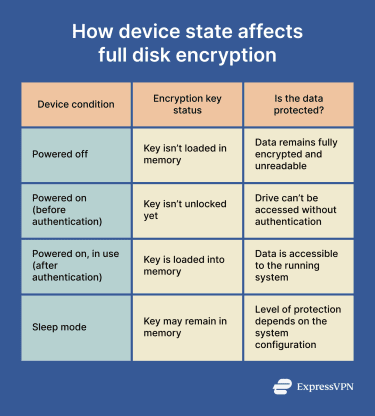
Types of full disk encryption
While the aim of FDE remains the same, there are different implementation approaches.
- Software-based encryption: Encryption is managed by the operating system or a dedicated application. Examples include built-in features in modern operating systems.
- Hardware-based encryption: Encryption is performed by the storage device itself, often through self-encrypting drives (SEDs), where encryption occurs directly on the drive hardware.
- Hybrid: Combines approaches where encryption occurs in hardware while key protection and policies are controlled by software or trusted hardware.
Benefits of full disk encryption
FDE provides several important security advantages, particularly for protecting data at rest, including:
- Limits the impact of device loss or theft: If a device or storage drive is stolen, the data remains inaccessible without the correct decryption key.
- Protects all data automatically: Encryption applies to the entire disk, including system files and user data, without requiring manual file-level protection.
- Prevents unauthorized offline access: Attackers cannot bypass security by removing the drive or booting from another operating system to read its contents.
- Supports regulatory compliance: Encryption helps organizations meet data protection requirements under frameworks such as the General Data Protection Regulation (GDPR).
- Strengthens overall security posture: FDE protects stored data and complements other safeguards that secure data in transit or in backup environments.
Risks and privacy concerns
FDE can be undermined by operational failures, weak authentication practices, or conditions that expose data after unlocking. Key risks include:
- Loss of recovery keys: If the encryption key or recovery credentials are lost, the data may become permanently inaccessible.
- Exposure while unlocked: Once a device is powered on and authenticated, malware or an attacker with access can still read the data.
- Key management complexity: In organizational environments, improper storage or handling of encryption keys can create operational or security risks.
- False sense of complete protection: FDE does not protect against phishing, weak passwords, insider threats, or network-based attacks.
Further reading
- What is data encryption?
- How to back up files and encrypt them
- How to encrypt a flash drive on Windows and Mac
- How to wipe a computer: Step-by-step guide