Expressvpn Glossary
DNS proxy

What is a DNS proxy?
A Domain Name System (DNS) proxy is a server that sits between a client device and a DNS server. It acts as an intermediary: instead of your computer talking directly to a public DNS server, it talks to the proxy first.
How does a DNS proxy work?
When a user enters a domain name, the proxy receives the query from the client device, processes it, and forwards it to an upstream DNS resolver, typically a recursive DNS resolver, which handles DNS lookups.
Depending on its configuration, the DNS proxy may cache results after receiving a valid response from the upstream resolver. This allows it to answer repeated queries locally and reduce latency and external DNS traffic.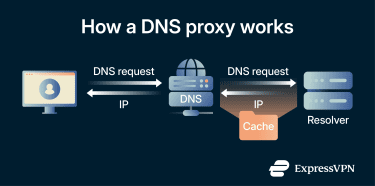
Types of DNS proxies
These are the main types of DNS proxies:
- Caching DNS proxy: Stores DNS responses after they are received from an upstream resolver and serves them locally until their time to live (TTL) expires. This reduces latency, lowers external DNS traffic, and improves overall network performance.
- Transparent DNS proxy: Intercepts DNS queries and redirects them to other DNS servers without the user’s knowledge. Some organizations use transparent DNS proxies to override user-configured DNS settings and enforce lookup policies and security filters.
- Filtering DNS proxy: Organizations can configure DNS proxies to filter queries by refusing to resolve certain domains. This helps prevent access to unauthorized or potentially malicious websites.
- Encrypted DNS proxy: Some proxies can use encrypted DNS protocols, like DNS over QUIC (DoQ), DNS over HTTPS (DoH), or DNS over TLS (DoT). This makes it difficult for third parties to monitor or interfere with DNS lookups.
Risks and privacy concerns
Common issues with DNS proxies typically include:
- Single point of failure: If only one DNS proxy is used and it goes down, all DNS lookups that depend on it will fail, impacting network functionality.
- DNS leaks: Improper DNS proxy configuration may cause routing issues, which can expose users’ DNS queries.
- Privacy concerns: Using untrusted third-party DNS proxy providers with unclear privacy policies can lead to DNS traffic being logged.
Further reading
- DNS security: How to protect your network from DNS threats
- DNS over QUIC (DoQ): What you need to know about the protocol
- Types of DNS servers: Everything you need to know
- Managed DNS: Complete guide to understanding and implementation