Expressvpn Glossary
Data center design
What is data center design?
Data center design is the process of planning and building secure, reliable facilities that house servers, networking equipment, and storage systems. It includes the physical layout of the facility or data hall as well as supporting infrastructure such as power distribution, cooling systems, and network architecture. The goal of data center design is to maintain consistent availability and performance while accounting for cost, scalability, and resilience.
How does data center design work?
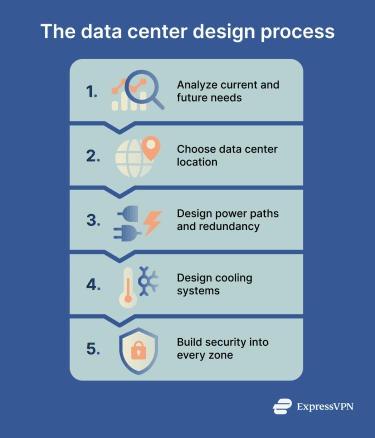
Data center design works by evaluating workload requirements, site characteristics, and operational risks, then translating them into a facility layout and supporting infrastructure.
Common considerations include:
- Workloads and capacity planning: Application demands, traffic patterns, and anticipated growth are assessed to estimate computing, storage, and network capacity needs.
- Site selection, risk, and compliance: Designers evaluate power availability, environmental risks, operating costs, and regulatory requirements that may affect long-term operations.
- Power architecture and redundancy: Power distribution models and redundancy levels are planned to reduce the impact of outages and eliminate single points of failure.
- Cooling and heat management: Cooling strategies are designed to manage heat generated by dense server environments and maintain stable operating conditions.
- Physical and logical security: Access controls, monitoring systems, and network segmentation are implemented to protect infrastructure and limit unauthorized access.
Types of data center designs
Data center design varies based on who operates the facility, where it’s located, and the workloads it supports.
Common types include:
- Enterprise on-prem data centers: Owned and operated by a single organization. These offer direct control over infrastructure and security but require significant upfront investment and ongoing maintenance.
- Colocation facilities and cages: Shared data centers where organizations rent space, power, and cooling while managing their own hardware. This model reduces facility overhead while still allowing customization at the hardware and network levels.
- Cloud hyperscale data centers: Large-scale facilities built by cloud providers to support massive, distributed workloads. These designs emphasize automation, standardization, and high levels of redundancy.
- Edge and micro data centers: Smaller facilities placed closer to end users or data sources. They are designed to reduce latency and support localized processing, often in remote or space-constrained environments.
- Modular and containerized data centers: Containerized data centers pack servers, networking, cooling, and power distribution into shipping-container-sized units that can be deployed quickly and expanded as needed.
Why is data center design important?
Data center design plays a central role in how reliable, secure, and efficient digital services remain over time. Redundant power, cooling, and network paths help prevent downtime during failures or maintenance, while segmentation and controlled access reduce security risks.
A well-planned layout also makes it easier to scale capacity, improve energy efficiency, and meet regulatory requirements without major disruption.
Risks and privacy concerns
Poorly designed data centers can introduce security weaknesses. For example, misconfigured networks may expose internal services to unauthorized access, while weak physical controls can allow device tampering or data theft.
In shared colocation environments, a lack of proper isolation increases the risk of tenant spillover, and inadequate logging can delay breach detection and incident response. In addition, supply chain hardware risks remain a concern, as compromised or counterfeit components may enter environments without strong vendor vetting and verification processes.
Further reading
- Internet infrastructure: What it is and how it works
- Network topology: Best practices for modern networks
- Network architecture: Building secure and modern networks
- What is network mapping? Complete guide